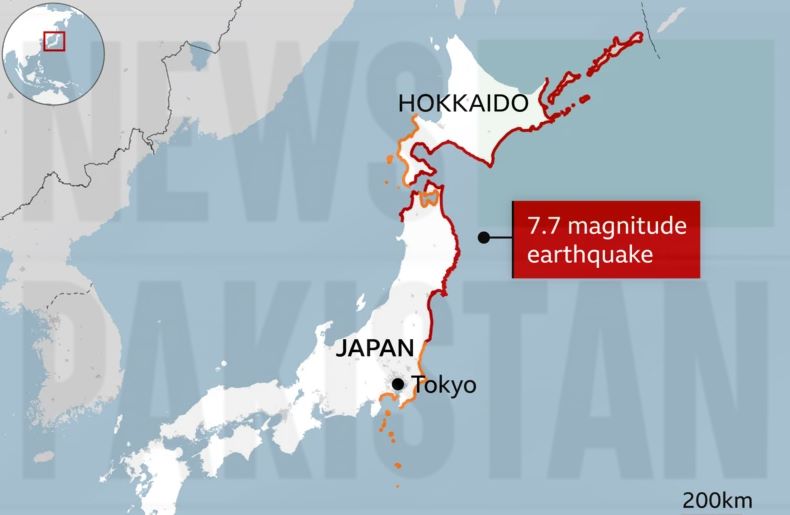
TOKYO: Following 7.7 magnitude tremors, that shook the region off the NE Coast, on 20th April, 2026, Japan has lifted tsunami warning, but told apropos more tremors.
Government, earlier notified that the height of the waves could be three meters. Citoyens living in coastal or river areas were asked to evacuate and go to higher surface.
According to the Fire and Disaster Management Agency one person in Aomori, north of Iwate, was wounded.
As far as the nuclear plants are concerned in the Aomori and Miyagi provinces, authorities proclaimed that no abnormalities had been reported.
It may be recalled that last year on 30th of July, following a 8.8 magnitude earthquake tsunami waves have lashed Japan, Russia and USA.
According to reports shallow earthquake damaged batiments and wounded number of citoyens in (far east) Russia, that has now lifted the warning. Coastal inhabitants of Hawaii have been ordered to get to high ground. It has now downgraded the warning. Japan have downgraded the alert, which was in its north.
IAEA took to the X to inform that it “is in contact with Japan national authorities about 8.8 magnitude earthquake off Russia’s east coast & resulting tsunami. Initial reports indicate no safety impact for nuclear power plants along Pacific coast. ALPS treated water discharge halted in line w/ safety protocols.”
Similarly, on 13th Jan, 2025 a 6.8-magnitude earthquake struck at a depth of 36 km, off the coast of Miyazaki Prefecture causing two moderate tsunamis. The Japan Meteorological Agency (JMA) has warned the citoyens to remain away from the sea as tsunami could occur anytime. It is pertinent to mention here that Japan experiences 18% of the world’s total number of tremors (i.e.: 1,500 tremors per annum).
Thousands of rescuers were battling blocked roads and poor weather to clear the wreckage as well as reach almost 3,500 people still stuck in isolated communities.
Ishikawa regional authorities released figures on Tuesday showing that 202 people were confirmed dead, up from 180 earlier in the day, with 102 unaccounted for, down from 120.
Authorities had more than tripled the number of missing to 323 after central databases were updated, with most of the rise related to badly hit Wajima.
But since then “many families let us know that they were able to confirm the safety of the persons (on the list)”, Ishikawa official Hayato Yachi told the Media.
With heavy snow in places complicating relief efforts, as of Monday, almost 30,000 people were living in around 400 government shelters, some of which were packed and struggling to provide adequate food, water, and heating.
Almost 60,000 households were without running water and 15,600 had no electricity supply. Road conditions have been worsened by days of rain that have contributed to an estimated 1,000 landslides.
At a daily disaster-relief government meeting on Tuesday, Prime Minister Fumio Kishida instructed ministers to “make efforts of resolving the state of isolation (of communities) and continue tenacious rescue activities”.
Kishida also urged secondary evacuations to other regions outside the quake-hit area, top government spokesman Yoshimasa Hayashi told reporters.
In Ishikawa prefecture’s city of Suzu, a woman in her 90s managed to survive five days under the wreckage of a collapsed house before being saved on Saturday.
“Hang in there!” rescuers were heard calling to the woman, in police footage from the rainy scene published by local media.
Not all were so lucky, with Naoyuki Teramoto, 52, inconsolable on Monday after three of his four children’s bodies were discovered in the town of Anamizu.
“We were talking of plans to go to Izu,” a famous hot spring resort, after his daughter passed her high school entrance exam, he told broadcaster NTV.
Japan experiences hundreds of earthquakes every year, though most cause no damage because of strict building codes in place for more than four decades.
But many structures are older, especially in rapidly aging communities in rural areas like Noto.
The country is haunted by the monster quake of 2011 that triggered a tsunami, left around 18,500 people dead or missing, and caused a nuclear catastrophe at the Fukushima plant.
Newspakistan.tv